Friday, April 25, 2014

BUDDHACARITA 10.16: Backward & Forward Steps


⏑−¦−⏑⏑¦−⏑−−¦¦−−⏑−¦−⏑⏑¦−⏑−−   Upajāti (Indravajrā)
tatrainam-ālokya sa rāja-bhtyaḥ śreṇyāya rājñe kathayāṁ cakāra |
⏑−¦−⏑⏑¦−⏑−−¦¦−−⏑−¦−⏑⏑¦−⏑−−
saṁśrutya rājā sa ca bāhumānyāt-tatra pratasthe nibhtānuyātraḥ || 10.16


10.16
That servant of the king, having seen him there,

Reported back to King Śreṇya.

And the king, having listened, out of great respect,

Set off in that direction, with only a modest retinue.


COMMENT:
Was the listening done out of great respect? Or was the size of the retinue determined out of great respect?

The word order tends to support the former reading, since saṁśrutya (having listened) and  bāhumānyāt (out of great respect) appear together in the 3rd pāda.

The latter reading is supported by the tradition, noted by EHJ, that It is more proper for a king to visit a saint with a small retinue.

This tradition, of which I was unaware when translating SN Canto 3, may have been pertinent to SN3.20:

atha pārthivaḥ samupalabhya sutam-upagataṁ tathāgataṁ /
And so the king learned that his son had arrived
as the Tathāgata, the One Arrived Thus;
tūrṇam-abahu-turagānugataḥ suta-darśanotsukatayābhiniryayau // 3.20 //
With but a few horses straggling behind him,
out the king charged, in his eagerness to see his son.

But, EHJ adds, in connection with today's verse, some versions of this legend make Bimbisāra go out with a large following and C [the Chinese translation] here gives 100,000 followers and may have read pratasthe 'nibhṛtānuyātraḥ, if it did not wilfully alter the sense.

The Chinese translation, however, is ever unreliable, and the line about 100,000 followers  (導從百千衆) is even less credible since, in my reading, it is appended to the Chinese translation not of today's verse but of tomorrow's verse.


Setting aside this uncertainty with regard to respect and retinues great and small, what is clear is that King Śreṇya/Bimbisāra is described as first listening, and then advancing into movement.

For a Zen patriarch such as Aśvaghoṣa was, though this description of the king's behaviour is unobtrusive, it might conceal high praise.

Ostensibly it is tomorrow's verse in which Aśvaghoṣa heaps praise on Bimbisāra, comparing him to a lion. But when we dig for the gold in today's verse, Aśvaghoṣa's gold might be quietly reflecting the essence of what the Zazen life is – namely, endless cycles of

  • (a) taking the backward step of turning our light around and coming back to what Alfred Tomatis called “the listening posture,” and
  • (b) charging forward and making one mistake after another.

In Shobogenzo chap. 14, Sansuigyo, Dogen wrote that there should be stepping backward and there should be stepping forward.

Today's verse as I read it is a pointer to that teaching. The backward step and forward steps. Listening and going into movement. Sitting-meditation and everyday life.


VOCABULARY
tatra: ind. there
enam (acc. sg. m.): him
ālokya = abs. ā- √ lok: to look at, behold
sa (nom. sg. m.): he
rāja-bhṛtyaḥ (nom. sg.): m. a king's servant , royal servant or minister

śreṇyāya (dat. sg.): Śreṇya
rājñe (dat. sg.): m. the king
kathayāṁ cakāra = 3rd pers. sg. periphrastic perfect kath: to tell , relate , narrate , report , inform , speak about , declare , explain , describe

saṁśrutya = abs. saṁśru: to hear or hear from, to listen attentively
rājā (nom. sg.): m. king
sa (nom. sg. m.): he
ca: and
bāhu-mānyāt: out of the great worthiness of honour
bahu: mfn. much , many , frequent , abundant , numerous , great or considerable in quantity
manya: mfn. to be respected or honoured , worthy of honour , respectable , venerable
bahu-māna: m. high esteem or estimation , great respect or regard for

tatra: ind. there, to that place
pratasthe pra- √ sthā: to advance towards; to proceed or march to
nibhṛtānuyātraḥ (nom. sg. m.): with a modest retinue
nibhṛta: mfn. borne or placed down , hidden , secret ; quiet , humble , modest , mild , gentle
anuyātrā/a: f/n. retinue , attendance ; that which is required for a journey.
a-nibhṛtānuyātraḥ (nom. sg. m): with no small retinue; with an imposing retinue

使見安住彼 次第具上聞
王聞心馳敬 即勅嚴駕行 

Thursday, April 24, 2014

BUDDHACARITA 10.15: The Matter of a Bodhisattva Going On Up


⏑−¦−⏑⏑¦−⏑−−¦¦⏑−⏑−¦−⏑⏑¦−⏑−−   Upajāti (Bhadrā)
tasminn avau lodhra-vanopagūḍhe mayūra-nāda-pratipūrṇa-kuñje |
⏑−¦−⏑⏑¦−⏑−−¦¦⏑−⏑−¦−⏑⏑¦−⏑−−
kāṣāya-vāsāḥ sa babhau n-sūryo yathodayasyopari bāla-sūryaḥ || 10.15


10.15
On that hill covered with lodhra groves,

Its thickets filled with the crying of peacocks,

Wearing the ochre robe, that human sun shone forth

Like the morning sun up above the eastern mountain.


COMMENT:
Nature in the raw with her verdant growth and abundant songs of birds tends to encourage us human beings, if we allow her, in a direction that can only be called up. That is why many of us, when we can, head for the hills or for the forest to recharge our batteries. That might also be one reason why the Buddha recommended Nanda to go and practice in solitude out in the wilds:

etāny-araṇyāny-abhitaḥ śivāni yogānukūlāny-ajaneritāni /
These salubrious wilds that surround us 
are suited to practice and not thronged with people.
kāyasya kṛtvā praviveka-mātraṃ kleśa-prahāṇāya bhajasva mārgam // SN16.86 //
Furnishing the body with ample solitude, 
cut a path for abandoning the afflictions.


So the first half of today's verse is about nature, but the real turning word in today's verse as I read it comes in the 4th pāda, and that word is upari.

In today's verse upari is used as a preposition indicating location (up above); at the same time upari can be used as an adverb indicating direction (up, upwards).

Shobogenzo chapter 28 is titled BUTSU-KOJO-JI, in which title the JO of KOJO means up. BUTSU-KOJO is a difficult phrase to translate. “Going Beyond Buddha” is one option, but that fails to convey the explicit sense of an upward orientation. “The Ascendant State of Buddha” struck me, on the basis of Alexander experience, as too static, and so in preparing Shobogenzo Book 3 for publication, I preferred “The Continuing Upwardness of Buddha.” (Therein lies a story which, if I told it again, might pull me down; so I won't.) Six years ago when I turned my hand to a freer translation in my own words, I translated the chapter title “The Matter of Buddha Going On Up.”

As I have written many times before on this blog, FM Alexander understood that the pursuit of “right posture” practised on military parade grounds and Japanese Zen dojos is a temporary descent into a kind of insanity – because there is no such thing as a right position. But there is such a thing as a right direction. And that direction is, primarily, up; or in Sanskrit, upari.

This is a matter, Dogen emphasizes in Shobogenzo chap. 28, not only for bodhisattvas but also for buddhas.

In the present series of verses, as I read it, Aśvaghoṣa is suggesting, conversely, that it was a matter that Gautama realized not only as the Buddha but also as a bodhisattva.

Thus in BC10.18 Aśvaghoṣa compares the bodhisattva sitting in full lotus to a rising moon; and in today's verse he compares the bodhisattva being alone in nature, wearing a kaṣāya, to the morning sun starting its ascent.


As a postscript, on further reflection, the yellow flowers of the lodhra tree might be agreeable to the eye and to the nose. Peacocks, in contrast, are said to have a raucous and repetitive cry that can be annoying to the untrained ear. So in today's verse also, it may be possible to trace a dialectic progression. 


VOCABULARY
tasmin (loc. sg. n.): that
vane [EBC] (loc. sg.): n. a forest , wood , grove , thicket , quantity of lotuses or other plants growing in a thick cluster (but in older language also applied to a single tree) ; plenty , abundance
avau = loc. sg. avi: m. a mountain
lodhra-vanopagūḍhe (loc. sg. n.): covered with groves of lodhra trees
lodhra: m. (prob. connected with rudhira) the tree Symplocos Racemosa (it has yellow flowers , and the red powder scattered during the holī festival is prepared from its bark)
upagūḍha: mfn. hidden , concealed , covered ; clasped round , embraced
upa- √ guh: to hide , cover , conceal

mayūra-nāda-pratipūrṇa-kuñje (loc. sg. n.): its bowers filled with crying of peacocks
mayūra: m. a peacock
nāda: m. a loud sound , roaring , bellowing , crying
pratipūrṇa: mfn. filled with , full of ; satisfied, contented
kuñja: m. a place overrun with plants or overgrown with creepers , bower , arbour

kāṣāya-vāsāḥ (nom. sg. m.): with his brown-red robe
kāṣāya: n. a brown-red cloth or garment
vāsas: n. cloth , clothes , dress , a garment
sa (nom. sg. m.): he
babhau = 3rd pers. sg. perf. bhā: to shine , be bright or luminous ; to shine forth
nṛ-sūryaḥ (nom. sg.): m. the sun of mankind, Bcar.

yathā: as
udayasya (gen. sg.): m. going up , rising ; the eastern mountain (behind which the sun is supposed to rise)
upari: ind. (as a separable adverb) above , upon , on , upwards , towards the upper side of (e.g. upari- √yā , to go upwards) ; (as a separable preposition , with acc. loc. , or gen.) over , above , upon , on , at the head of , on the upper side of , beyond (e.g. upari śailaṁ- √gam , to go over the mountain)
bāla-sūryaḥ (nom. sg. m.): the newly-risen sun
bāla-sūrya: n. lapis lazuli
bāla: mfn. young ; newly risen , early (as the sun or its rays)
sūrya: m. the sun

青林別高崖 丹華殖其間
孔雀等衆鳥 翻飛而亂鳴
法服助鮮明 如日照扶桑


Wednesday, April 23, 2014

BUDDHACARITA 10.14: Directed Arising, in Four Steps


⏑−¦−⏑⏑¦−⏑−−¦¦⏑−⏑−¦−⏑⏑¦−⏑−−   Upajāti (Bhadrā)
ādāya bhaikṣaṁ ca yathopapannaṁ yayau gireḥ prasravaṇaṁ viviktam |
⏑−¦−⏑⏑¦−⏑−−¦¦⏑−⏑−¦−⏑⏑¦−⏑−−
nyāyena tatrābhyavahtya cainan-mahī-dharaṁ pāṇḍavam-āruroha || 10.14


10.14
Having accepted whatever food was offered,

He went to a solitary mountain spring,

And there, according to principle, he ate that food,

And went up the hill of the Pāṇḍavas.


COMMENT:
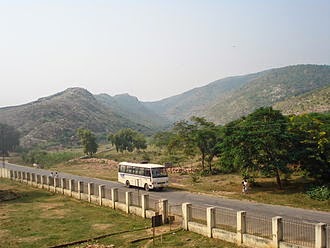
The Pāṇḍava mountain, according to a note by PO, is the north-easterly of the five hills around Rājagṛha, and the name refers to the Mahābhārata episode where Kṛṣṇa, Ārjuna and Bhima approach the city across these hills to kill its king, Jara-sandha.

The Wikipedia entry on Rājagṛha (now called Rajgir) happens to have a photo which shows two or three of the hills.


But the geography, history and mythology of the hill in today's verse, as I read it, are incidental. The point is that when the bodhisattva went up the hill, that going up was a metaphor for what the Buddha would later teach as pratītya-samutpāda, "springing up totally, with direction" or, more succinctly, "directed arising." 

Read in this light, today's verse is another one that follows a four-phased dialectic process, culminating in a suggestion of the practice and experience of going up in sitting.


In the first pāda the key word is yathopapannam, which expresses non-discriminating acceptance. When it comes to food, that means accepting and eating whatever has been offered. For a practising bodhisattva, the Buddha reminds Nanda in SN Canto 14, picking and choosing of food is strictly off limits:

yasmān-nāsti vināhārāt sarva-prāṇabhṛtāṃ sthitiḥ /
Since without food there is none that survives among those that bear breath,
tasmād duṣyati nāhāro vikalpo 'tra tu vāryate // SN14.9 //
Therefore eating food is not a sin; but being choosy, in this area, is prohibited.

When it comes to sitting-meditation, the same principle of non-discriminating acceptance was expressed by Zen Master Dogen with eight Chinese characters which mean “Don't think good, bad. Don't care right, wrong.”

Yesterday on BBC Radio 4 I happened to hear an account by Martin Sixsmith of Sigmund Freud's early efforts to access the unconscious mind. Freud apparently regarded the technique of getting his patient to practise free association as a kind of breakthrough. And to that end it seems Freud asked the patient to suspend her critical faculties in relation to whatever association came up.

When one reflects on the function of the Moro reflex, this approach in the direction of healing makes a lot of sense, since thinking that something is bad and wrong, in a person suffering from an aberrant Moro reflex, will tend to trigger undue emotional responses – thereby undermining that cornerstone of direction that Nāgārjuna called hetu, “the motivational.”


The 2nd pāda is antithetical to the first in affirming the separateness of a mountain spring described as viviktam, which means solitary, isolated, set apart, segregated, discriminated.

In SN Canto 17, Aśvaghośa uses the same word viviktam to describe the 1st dhyāna as separated or distanced from desires and tainted things:

kāmair-viviktaṃ malinaiś-ca dharmair-vitarkavac-cāpi vicāravac-ca /
Distanced from desires and tainted things, 
containing ideas and containing thoughts,
viveka-jaṃ prīti-sukhopapannaṃ dhyānaṃ tataḥ sa prathamaṃ prapede // SN17.42 //
Born of solitude and possessed of joy and ease, 
is the first stage of meditation, which he then entered.

I have discussed in several past posts whether in the second half of SN17.42, viveka-jam is best understood as “born of solitude” (as I originally translated it) or as “born of discrimination” (as EHJ and LC translated it).

Viviktam and viveka are both from the root vi-√vic, which originally means to sift out or separate out (especially to sift out grain by tossing or blowing). By extension vi-√vic means to distinguish, to discriminate, to investigate, or to deliberate So vivikta and viveka in essence mean the same thing, vivikta being the adjectival past participle (separated, isolated, distanced, set apart, distinct) and viveka being the noun (separateness, distinction, discrimination).

To preserve this sense of two words with a common root, if I had to translate SN17.42 now, I think I would translate vivikta as “separated” and viveka as “separateness”:
Separated from desires and tainted things, containing ideas and containing thoughts, / Born of separateness, and possessed of joy and ease, is the first stage of meditation, which he then entered. // SN17.42 //
In today's verse, evidently, at least on the surface, viviktam describes the mountain spring as solitary, i.e., as physically separated or isolated from people, rather than as set apart in anybody's mind. But either way, there is an opposition in the first two pādas, as I read them, between non-discrimination and separateness, both of which might be useful weapons in our armoury as Zen practitioners.


The 3rd pāda, then, expresses the synthesis. And that synthesis, as my teacher never tired of asserting, is “action in the balanced state of body and mind.” Since those words are rather static, I would prefer to call it something like “directed action” or “acting with direction.” But whatever we call it, action like that is I think what is suggested by the 3rd pāda of today's verse.

Then finally the 4th pāda, as I have suggested already, might be a metaphor for pratītya-samutpāda, springing up with direction, or directed arising

A few weeks ago, when I came back to Nāgārjuna's mūla-madhyamaka-kākarikā, on the basis of these past six years of being taught Sanskrit mainly by Aśvaghoṣa himself, I knew straight away that pratītya-samutpāda had to be an expression of sitting-meditation itself. Otherwise, Dogen did not know what he was talking about.

As an expression of sitting-meditation, especially in light of Alexander experience, samutpāda works perfectly well. The dictionary gives the noun samutpāda as “rise,” from the verbal root sam-ut-√pad, "to spring up together."

The difficulty is in understanding the pratītya, in which direction I have been helped by a certain Sankrit paṇḍit who I consult from time to time on thorny issues. He informed me that pratītya was not as I had originally thought a gerundive from prati-√i (“to be gone towards”). I had jumped to this wrong conclusion mainly on the basis of the definition of pratītya in the MW dictionary, which includes in parenthesis mfn. to be recognized. So my first stab at translating pratītya-samutpāda was “What waits to be realized, as a springing up together.”

After he had informed me that prati-√i is better understood as an absolutive (“after going towards”), I then tried again with “What has been Realized as a Springing Up Together.”

This also got knocked back, on the basis that pratītya-samutpāda should be a kind of samutpāda.

So I asked my paṇḍit friend to help me out by suggesting his own translation, and he wrote me:

If you would like to continue to play around with the kind of English vocabulary that you were leaning towards, a rendering that reflects the structure of the Sanskrit better might for instance be Springing Up With Realization.

This struck me when I read it as an expression that would have met with the wholehearted approval of Gudo Nishijima. Perhaps it deserves to stand, as a succinct and meaningful translation of pratītya-samutpāda: “Springing up with realization.” But on reflection it fails to convey the sense inherent in pratītya of going or having gone (itya) in a direction (prati). So I decided to substitute “direction” for “realization” and thus arrived at Springing Up Together, with direction.

As an expression of the essence of sitting-meditation, this seemed to me to come pretty close to hitting the target.

Then two or three days ago I came across Ānandojiti Bikkhu's translation of Paṭiccasamuppādavibhaṅga, The Analysis of Conditional Origination, in which paṭiccasamuppāda (the Pali equivalent of pratītya-samutpāda) is rendered Conditional Origination. It caused me to reflect that maybe a more ecumenical translation of pratītya-samutpāda was also desirable – one that sounded like an expression (at the fourth phase) of the essence of sitting-meditation, but which also fitted as a description of the twelve links in the chain of cause and effect, which the Buddha also taught and which is the theme of Paṭiccasamuppādavibhaṅga.

So the phrase that springs to mind this morning is Directional Arising.

I submit that 
  • 1. Directional/Directed Arising is a literal translation of pratītya-samutpāda, 
  • 2. Directed Arising sounds like a Zen patriarch's expression of going up in sitting-meditation, and 
  • 3. The Analysis of Directional Arising might even fit as a title of Paṭiccasamuppāda-vibhaṅga.
I am probably wide of the mark with this, as I was when my first attempt at translating pratītya-samutpāda was batted away so easily by somebody who understands Sanskrit much better than I do. But I certainly do not regret venturing that wrong translation and having my understanding corrected. Whatever I have learned in 54 years (which some might say is evidently not much) I have learned like that. 


VOCABULARY
ādāya = abs. ā- √ dā: to give to onself, take, receive, accept
bhaikṣam (acc. sg.): n. anything obtained by begging , begged food , charity , alms
ca: and
yathopapannam (acc. sg. n.): mfn. just as may happen to be at hand , just as happened , just as occurring , unconstrained , natural

yayau = 3rd pers. sg. perf. yā: to go
gireḥ (gen. sg.): m. a mountain
prasravaṇam (acc. sg.): n. streaming or gushing forth , trickling , oozing , effusion , discharge ; a well or spring
viviktam (acc. sg. n.): mfn. separated , kept apart , distinguished , discriminated ; isolated , alone , solitary ; pure , clean , neat , trim ; clear , distinct

nyāyena: m. that into which a thing goes back i.e. an original type , standard , method , rule , (esp.) a general or universal rule , model , axiom , system , plan , manner , right or fit manner or way , fitness , propriety; : (inst.) " in the right manner , regularly , duly " ,
tatra: ind. there
abhyavahṛtya = abs. abhy-ava- √ hṛ: to throw down into water, to take food, eat
ca: and
enat (acc. sg. n.): this, that [begged food]

mahī-dharam (acc. sg.): m. “earth-bearing”; a mountain
pāṇḍavam (acc. sg.): m. N. of a mountain ; belonging to or connected with the pāṇḍavas
āruroha = 3rd pers. sg. perf. ā- √ ruh: to ascend


精麁隨所得 持鉢歸閑林
食訖漱清流 樂靜安白山

Tuesday, April 22, 2014

BUDDHACARITA 10.13: Being In No Rush to Get Anywhere


⏑−⏑−¦−⏑⏑¦−⏑−−¦¦⏑−⏑−¦−⏑⏑¦−⏑−−   Upajāti (Upendravajrā)
a-lola-cakṣur-yuga-mātra-darśī nivtta-vāg-yantrita-manda-gāmī |
⏑−⏑−¦−⏑⏑¦−⏑−−¦¦⏑−⏑−¦−⏑⏑¦−⏑−−
cacāra bhikṣāṁ sa tu bhikṣu-varyo nidhāya gātrāṇi calaṁ ca cetaḥ || 10.13

10.13
Looking, with eyes that did not dance, a yoke's length ahead;

Not speaking; moving slowly and with restraint,

He the best of beggars, however, went begging –

Placing within limits his limbs and the inconstant mind.


COMMENT:
The tu (but, however) in the 3rd pāda of today's verse seems designed to serve as a reminder that, yes, there is a such a thing as a right direction, BUT there need be no desperate hurry to go in it.

What today's verse as I read it describes is an absence of impatient thirsting, which is associated with a certain conscious use of the eyes, limbs, and mind -- in which, to use a favourite phrase of Marjory Barlow, borrowed from TS Elliot, there is "stillness without fixity." 

If, in trying to be right, we imitated that kind of use of the eyes and limbs, and thereby ended up going around very slowly and carefully like a mindfulness zombie, that ironically might be just an insidious variation on the theme of impatient thirsting.

This is something that I have seen a lot in Alexander work, mainly in my own stupid self, whereby the impatient desire to feel myself going up causes me to pull myself down.


VOCABULARY
a-lola-cakṣuḥ (nom. sg. m.): with eyes that did not dance/wander/deviate
lola: mfn. moving hither and thither , shaking , rolling , tossing , dangling , swinging , agitated , unsteady , restless ; desirous , greedy , lustful
lola-cakṣus: mfn. having a rolling eye ; looking wantonly upon (loc.)
yuga-mātra-darśī (nom. sg. m.): mfn. looking as far as a yoke or towards the ground.
yuga: m. a yoke ; a measure of length = 86 aṅgulas (= 4 hastas or cubits)
mātra: n. measure; e.g. aṅgula-mātram , a finger's breadth
darśin: mfn. ifc. seeing , looking at
EBC note: Hardy explains this ‘he does not look before him further than the distance of a plough of nine spans’ (Manual of Buddhism, p. 371).

nivṛtta-vāg (nom. sg. m.):
nivṛtta: mfn. turned back ; passed away , gone , ceased , disappeared , vanished
vāc: f. speech , voice , talk , language
yantrita-manda-gāmī (nom. sg. m.):
yantrita: mfn. restrained , curbed , bound , fettered , confined (lit. and fig.)
yantṛ: to restrain , curb , bind
manda: slow , tardy , moving slowly or softly ; languid
gāmin: ifc. going or moving on or in or towards or in any peculiar manner

cacāra = 3rd pers. sg. perf. car: to move one's self , go , walk , move , stir , roam about , wander
bhikṣām (acc. sg.): f. the act of begging or asking (with √ kṛ , to beg ; with √ aṭ , car , bhram and yā , to go about begging)
sa (nom. sg. m.): he
tu: but
bhikṣu-varyaḥ (nom. sg. m.): the best of beggars

nidhāya = abs. ni- √ dhā : to put or lay down , deposit , lay up , preserve ; (with manas) to fix or direct the thoughts upon or towards i.e. resolve ; (with manasi , °sā , or hṛdaye) to keep in mind , bear in mind , remember ; to keep down, restrain
gātrāṇi (acc. pl.): n. " instrument of moving " , a limb or member of the body
calam (acc. sg. n.): mfn. moving , trembling ; unsteady
ca: and
cetaḥ (acc. sg.): n. mind

澄靜端目視 庠歩顯眞儀
入里行乞食 爲諸乞士光
歛形心不亂 好惡靡不安

Monday, April 21, 2014

BUDDHACARITA 10.12: Wanting to Know the Direction of Going


⏑−⏑−¦−⏑⏑¦−⏑−−¦¦−−⏑−¦−⏑⏑¦−⏑−−   Upajāti (Ārdrā)
tataḥ śrutārtho manasāgatārtho rājā babhāṣe puruṣaṁ tam-eva |
⏑−¦−⏑⏑¦−⏑−−¦¦⏑−⏑−¦−⏑⏑¦−⏑−−
vijñāyatāṁ kva pratigacchatīti tathety-athainaṁ puruṣo 'nvagacchat || 10.12


10.12
Then, having learned the motive,
having been motivated in his own mind,

The king told that same man:

“Let me know in what direction he is going!”

The man said “So be it!” and followed him.

COMMENT:
On the surface, following the superficial track of the two preceeding verses, śrutārthaḥ in today's verse describes the king as having heard the meaning, or having heard the gist; and manasāgatārthaḥ describes the king as having perceived (lit. arrived at) that meaning with his mind.

Hence EBC translated the 1st pada of today's verse, “having heard this and perceived its meaning with his mind...”

EHJ must have felt that the repetition of artha was redundant, and maybe not worthy of such an elegant poet as Aśvaghoṣa, and so he amended the second artha to āstha, and translated manasāgatāsthaḥ as “was excited in mind.”

“Then the king, on hearing the reason, was excited in mind...” [EHJ]
“When he heard the reason, then, confidence returned to the mind of the king...” [PO]

Below the surface, following the buried meaning of the two preceding verses, the two artha can be understood as expressing not so much “meaning” or “reason,” but – like the original hetu of BC10.10 – “motive.”

In that case, the compound āgatārtha (lit. arrived at motivation) might be read as meaning “motivated” in the same way that, for example, ā́gata-kṣobha (lit. “arrived at agitation”) means confounded or perplexed.

In that case, again, as in yesterday's verse we are dealing not so much with intellectual curiosity as with a deeper motivation. Not so much a desire to know a fact as a desire to go in the direction of ultimate knowing.

That, I think, is the light in which we are intended to read the 3rd pāda of today's verse.

So when King Śreṇya says “Let me know in what direction he is going!”, the king's motivation might be something more than intellectual curiosity, and more than fear of an implicit threat to the prevailing value system of Rājagṛha.

This accords with what we know, from the Pali suttas, of the steps that
Śreṇya, aka Bimbisāra, subsequently took in the direction of ultimate knowing.

In the introduction to his translation of Mahākhandhako (The Great Chapter), Ānandajoti Bhikkhu writes, in connection with the Fourth Section of this text belonging to the Vinaya (Disciple) collection of the Theravada suttas:
Following the conversion of the Kassapas and their one thousand followers, the Buddha goes with them to Rājagaha, the capital of Magadha. King Bimbisāra hears that he has come to his Royal Capital and along with twelve thousand of his fellow citizens he goes out to meet him, fulfilling some wishes he had made while still a prince.
The Buddha teaches them a discourse at this point, but only a synopsis is given in the Pāḷi text, while in the Mahāvastu the full discourse is given. After the discourse the King goes for refuge to the Three Treasures and invites [the Buddha] for a meal on the following day, after which he donates the Bamboo Wood to the Buddha, thus ensuring the material establishment of the Dispensation.

The text and translation of the episode in which the King donates the Bamboo Wood to the Buddha can be found here.

The workrate and general devotion to the cause of Ānandajoti Bhikkhu, quite honestly, put me to shame. 

In consulting his website yesterday to find the above reference to King Bimbisāra, I noticed that Ānandajoti Bhikkhu has just this month published The Analysis of Conditional Origination, which is AB's translation of Paṭiccasamuppādavibhaṅga,

Paṭiccasamuppāda is the Pali equivalent of pratītya-samutpāda.

That Pali text evidently contains a detailed consideration of the twelvefold chain of causation. The text begins (AB's translation): 

Avijjāpaccayā saṅkhārā,

With ignorance as condition there are (volitional) processes,

saṅkhārapaccayā viññāṇaṁ,

with (volitional) processes as condition: consciousness....


The Pali paccayā thus appears to be an instrumental form of the Pali word corresponding to the Sanskrit pratyayaAnd my guess is that also in the Pali there might originally be more of a sense of direction than is conveyed by “with so and so as condition.”

So could the above two lines be translated for example as “Ignorance leads in the direction of (volitional) processes, (volitional) processes in the direction of consciousness....”?

Might a truer translation of paṭiccasamuppāda, then, rather than “conditional origination” be something like “directional origination” or “directional springing up”?

At one point in the Majjhima Nikaya (Middle Length Discourses), AB reports, the Buddha went to so far as to state:

He who sees conditional origination sees the Dhamma, 
 and he who sees the Dhamma sees conditional origination.

MN 28: Yo paṭiccasamuppādaṁ passati so Dhammaṁ passati, 
yo Dhammaṁ passati so paṭiccasamuppādaṁ passati.

The subject, however, is complex and even when Ven Ānanda said he had understood it, he was rebuked by the Buddha, who told him:
This conditional origination is deep, Ānanda, and it appears deep. Through not understanding and penetrating this Dhamma this generation ... he does not transcend the downfall, the bad destinations, the falling away and the cycle of birth and death.
DN 15: Gambhīro cāyaṁ, Ānanda, paṭiccasamuppādo gambhīrāvabhāso ca. Etassa, Ānanda, Dhammassa ananubodhā appaṭivedhā evam-ayaṁ pajā ... apāyaṁ duggatiṁ vinipātaṁ saṁsāraṁ nātivattati.
In the coming centuries when the Abstract Teaching (Abhidhamma) was compiled, the depth and profundity of this particular teaching was worked out in detail, and in the Vibhaṅga it has been pushed to its limits.


So what is written in the Majjhima Nikaya in Pali tends strongly to corroborate what Nāgārjuna wrote in Sanskrit at the beginning of his mūla-madhyamaka-kākarikā, that what the Buddha taught was just pratītya-samutpāda.

And at the same time none of us, including yours truly, should be too quick to jump to the conclusion that we have really understood what pratītya-samutpāda means.

But what I do know, what I would stake my life on, what I already in some sense staked my life on, is that there is no such thing as a right position, but there is such a thing as a right direction. And the words pratītya, and pratyaya, both apparently being derived from prati-√i (prati = towards, in a direction; √i = to go), seem to me to be pointing in a direction.

Coming back to today's verse, but still speaking of verbal roots meaning to go, with a prefix meaning in a direction, the 3rd pāda of today's verse has pratigacchati, “he is going [in a direction],” from prati-√gam, which lit. means “to go towards,” Or then again, it can sometimes mean “to go back.”

Yesterday's verse had adhigamiṣyati, “he will realize,” from adhi-√gam, lit. to go up to, or to go over and above, or to go beyond.

And the canto title is śreṇyābhigamanaḥ, which might mean “Śreṇya Approaching,” or might mean “Meeting Śreṇya.” Either way, abhigamana is from abhi-√gam, lit. to go near to.

EHJ translated śreṇyābhigamanaḥ as “Śreṇya's Visit” and PO as “Encounter with King Śreṇya.”

My inclination at present is to translate śreṇyābhigamanaḥ as “Śreṇya's Approach” or, more literally, “Śreṇya Approaching.” I think the ambiguity that Aśvaghoṣa may have intended was that on the surface Śreṇya's approach or Śreṇya's proposal was in the wrong direction – in the direction of earthly power (pṛthivī-śriyam) rather than ultimate knowing (jñānaṁ param). But below the surface, in light of future developments like the donation of the Bamboo Wood, we can guess that Aśvaghoṣa saw that Śreṇya was going in the right direction, that as a bodhisattva in his own right he was approaching ultimate knowing.


VOCABULARY
tataḥ: ind. then, on those grounds
śrutārthaḥ (nom. sg.): m. any matter ascertained by hearing
artha: n. aim, purpose ; cause , motive , reason ; sense , meaning , notion
manasā (inst. sg.): n. mind
āgatārthaḥ (nom. sg. m.): [EBC: having perceived its meaning]
āgatāsthaḥ [EHJ] (nom. sg. m.): mfn. full of interest [EHJ: was excited in mind ; PO: confidence returned to the mind]
āgata: mfn. come , arrived ; entered (into any state or condition of mind)
ā́gata-kṣobha: mfn. confounded , perplexed
kṣobha: m. shaking , agitation , disturbance , tossing , trembling , emotion
ā-sthā: f. consideration , regard , care ; assent , promise ; confidence , hope

rājā (nom. sg.): m. the king
babhāṣe = 3rd pers. sg. perf. bhāṣ: to speak, tell
puruṣam (acc. sg.): m. man, human being
tam (acc. sg. m.): him
eva: (emphatic)

vijñāyatām = 3rd pers. passive imperative vi- √ jñā: to distinguish , discern , observe , investigate , recognize , ascertain , know , understand ; to have right knowledge
kva: ind. where
pratigacchati = 3rd pers. sg. prati- √ gam: to go towards , go to meet ; to go back , return , go home
iti: “...,” thus

tathā: ind. yes , so be it , so it shall be (particle of assent , agreement , or promise ; generally followed by iti)
iti: “...,” thus
atha: ind. and so
enam (acc. sg. m.): this , that (Grammarians assert that the substitution of enam &c for imam or etam &c takes place when something is referred to which has already been mentioned in a previous part of the sentence)
puruṣaḥ (nom. sg.): m. man, human being
anvagacchat = 3rd pers. sg. perf. anu- √ gam: to go after, follow


王聞心驚喜 形留神已馳
勅使者速還 伺候進趣宜
奉教密隨從 瞻察所施爲

Sunday, April 20, 2014

BUDDHACARITA 10.11: Towards Ultimate Knowing


⏑−¦−⏑⏑¦−⏑−−¦¦−−⏑−¦−⏑⏑¦−⏑−−   Upajāti (Rāmā)
jñānaṁ paraṁ vā pthivī-śriyaṁ vā viprair-ya ukto 'dhigamiṣyatīti |
⏑−⏑−¦−⏑⏑¦−⏑−−¦¦⏑−⏑−¦−⏑⏑¦−⏑−−
sa eṣa śākyādhipates-tanū-jo nirīkṣyate pravrajito janena || 10.11

10.11
"Ultimate knowing, or else earthly power,

Inspired sages said he would realize:

It is he, the son of the Śākya ruler,

Who, having gone forth, is being admired by the people."


COMMENT:
On the surface King Śreṇya asked the reason for the crowd's gathering, and some bloke told him the reason, which was that the people were all gawping at the marvel of a royal prince who had gone forth into the life of a wandering beggar. In that case, the answer to the king's question is contained in the second half of today's verse. The reason the crowd gathered was to gaze at the prince.

But below the surface, as I argued yesterday, the king was inquiring into the motive behind all the activity, and the motive was the bodhisattva's desire to realize ultimate knowing. In that case, the answer to the king's question is contained in the first two words of today's verse – jñānaṁ param. The motive behind everything was ultimate knowing.

Speaking of knowing, FM Alexander said that to know when we are wrong is all that we shall ever know in this world.

In those terms, the highest order of knowing might include insight into faulty sensory appreciation and its causes.

But I think that Aśvaghoṣa is rather intending to suggest with jñānaṁ param a still higher order of knowing, namely, direct experience of what does not belong in the realm of knowable knowledge. Ultimate knowing, then, might be not so much knowledge as realization.

So again I come back to Nāgārjuna's assertion, which has been occupying my mind of late, that what the Buddha taught was just pratītya-samutpāda, or All Springing Up Together, with direction.

Buddhist scholars in the past have translated pratītya-samutpāda as “dependent origination” – a doctrine that does belong in the realm of knowable knowledge.

But Zen Master Dogen, as a distant descendant of Aśvaghoṣa and Nāgārjuna, took pains to clarify that what has been transmitted by the Zen patriarchs is just the practice and experience of sitting in full lotus. And this practice and experience, I submit, can never be expressed by a phrase like “dependent origination.” Springing Up Together, with direction, also does not hit the target – insofar as the target cannot be hit with words. But as a pointer to what is called in today's verse jñānaṁ param “ultimate knowing,” I submit that All Springing Up Together, with direction is – as a translation of pratītya-samutpāda which is literal enough and which has meaning – in the right general area.


VOCABULARY
jñānam (acc. sg.): n. knowing , becoming acquainted with , knowledge , (esp.) the higher knowledge (derived from meditation on the one Universal Spirit)
param (acc. sg. n.): mfn. highest, of the highest order
vā: or
pṛthivī-śriyam (acc. sg. f.): earthly majesty ; power over the earth
pṛthivī: f. the earth or wide world
śrī: f. light, glory; prosperity, wealth, treasure ; high rank , power , might , majesty , royal dignity
vā: or

vipraiḥ (inst. pl.): a sage , seer , singer ; a Brahman ; mfn. stirred or excited (inwardly) , inspired , wise (said of men and gods , esp. of agni , indra , the aśvins , maruts &c ; cf. paṇḍita)
yaḥ (nom. sg. m.): [he] who
uktaḥ (nom. sg m.): mfn. said
adhigamiṣyati = 3rd pers. sg. future adhi- √ gam: to go up to, accomplish, realize
iti: “....,” thus

sa (nom. sg. m.): he
eva (emphatic)
eṣaḥ (nom. sg. m.): mfn. this, this here ; sometimes used to give emphasis to the personal pronouns
śākyādhipateḥ (gen. sg. m.): of the Śākya ruler
tanū-jaḥ (nom. sg.): m. 'born of the body'; son

nirīkṣyate = 3rd pers. sg. passive nir- √ īkṣ: to look at or towards , behold , regard , observe (also the stars) , perceive
pravrajitaḥ (nom. sg. m.): one who has left home to become a religious mendicant
pra- √ vraj: to go forth ; to leave home and wander forth as an ascetic mendicant
janena (inst. sg.): m. people

昔聞釋氏種 殊特殊勝子
神慧超世表 應王領八方

今出家在此 衆人悉奉迎